
Outlook
Nieuwe DAS-aanvraag
Berenschot connects consultants and interim professionals with assignments at government and semi-public organizations. Together with Yarado, the consultancy firm automated the processing of requests from more than 22 hiring portals, allowing the Realization Desk to focus on the exceptions.

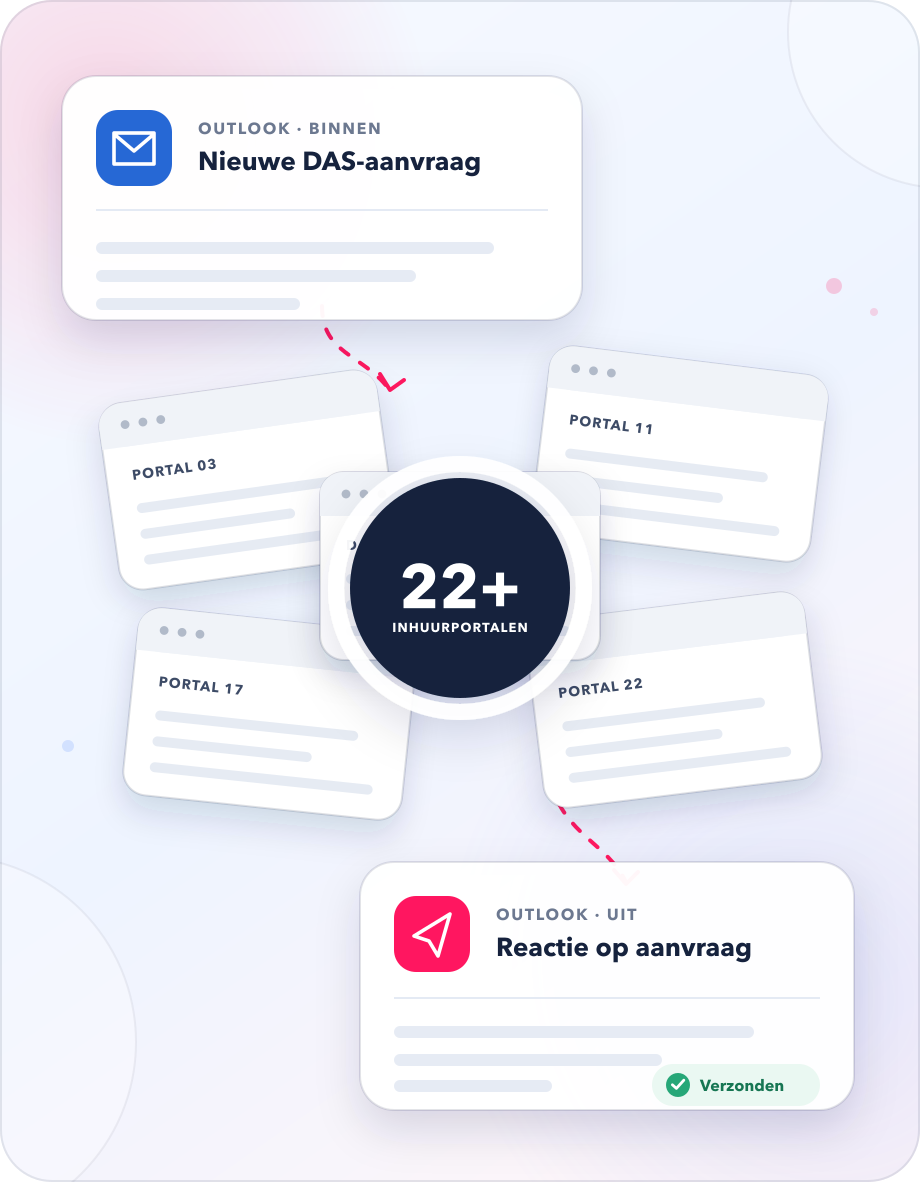
Every new request arrived via email, but the information needed to assess it was behind a link to an external portal. A Realization Desk employee had to identify the correct portal, log in, find the request, gather the assignment details, requirements, deadline, and documents, check if the request met Berenschot's criteria, and draft a response.
By relying primarily on one or two hiring sources, Berenschot could only monitor a limited portion of the available opportunities. Adding more sources solved this but also brought more recurring work within portals. Berenschot now processes requests from more than 22 portal routes, including Mercell, Flextender, Yacht, Circle8, Magnit, Flexhuis, and municipal platforms. Login procedures, page layouts, and document formats vary by portal, and many require multi-factor authentication.

Requests handled fully automatically

Requests to the Realization Desk for manual follow-up

Processed via one automated process
For every incoming request, a Realization Desk employee followed the link from the email, logged into the correct portal, and searched for the request. The employee gathered the assignment details, requirements, deadline, and requesting organization, read any attachments, checked the request against Berenschot's criteria, and drafted a response.
Even a simple request took an estimated five to ten minutes. Unknown portals, unclear information, and requests with multiple documents took more time. Expanding to more hiring sources therefore meant that the same actions were repeated in an increasing number of systems.
When a request arrives in Berenschot's Outlook mailbox, the automation recognizes the source, follows the link, and opens the request in the correct portal. The automation gathers the information Berenschot needs to evaluate the request and also downloads the associated documents from Mercell.
Next, the automation checks the request against Berenschot's criteria and drafts a structured response. If the information is complete and the request can be assessed with sufficient certainty, Outlook sends the response to the requesting organization. The automation only reads information from the hiring portals; responses are not submitted through the portals.
If a portal is unrecognized, information is missing, or the assessment is uncertain, the automatic processing stops and the request is sent to the Realization Desk for manual follow-up.
Over twelve months, 4,149 out of 4,490 requests followed the standard route and were processed automatically. The remaining approximately 341 requests went to the Realization Desk because they required human attention.
This allows Berenschot to process requests from more hiring sources without the team having to manually handle every incoming email and portal task. People remain responsible for cases where context or a judgment call is required.
According to Berenschot, the automation now handles a volume of recurring work in portals and email equivalent to one full-time position. That capacity remains available for exceptions, context, and decision-making—the work that still requires human input.
The same process now works for more than 22 portal routes. Standard requests proceed automatically; unknown portals, missing information, and uncertain assessments go to the Realization Desk. This allows Berenschot to monitor more hiring sources without each additional source creating an equal amount of new manual work.
We will map out the first practical step for your process.